You’ve found the perfect floor plan online: a living room with large windows, comfortable bedrooms, and a stylish facade. It seems like the job is done — all that’s left is to hand the image over to the builders. But this is exactly where the path usually begins — one that can lead to construction delays, legal disputes, or massive cost overruns.
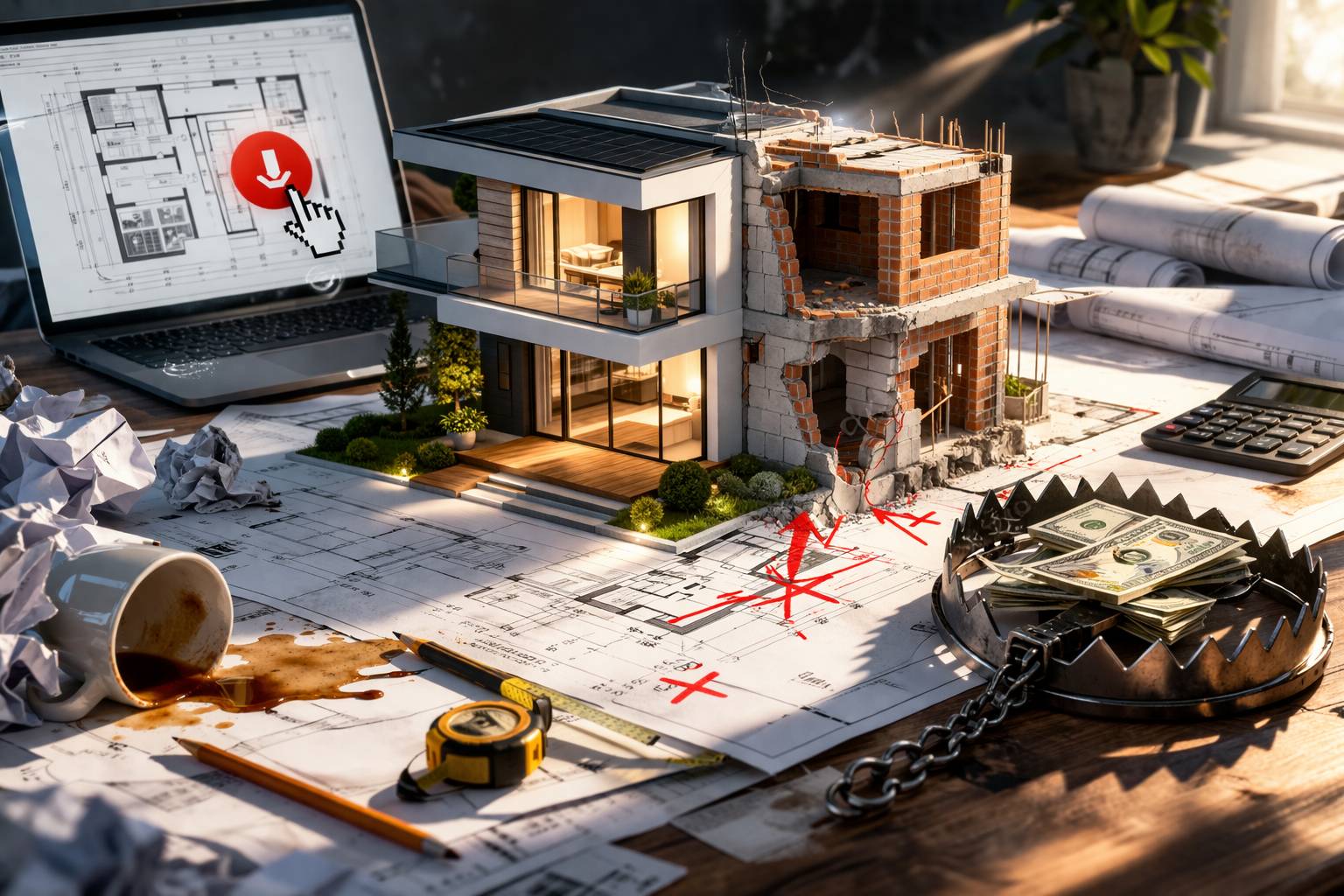
1. A beautiful picture is not a foundation
A free online plan doesn’t account for what’s on your land — sand, clay, or high groundwater levels.
Risk: A standard foundation may crack under the weight of the walls or, conversely, be unnecessarily oversized and expensive where it’s not needed.
Solution: A custom structural calculation based on soil analysis can save you thousands of dollars on concrete and reinforcement.
2. Legal dead end: red lines and building codes
Online projects often do not comply with Ukrainian state building regulations (DBN).
Risk: You start construction only to discover that you’ve violated setback requirements or built over a municipal gas line. The result — inability to commission the building and potential fines.
Solution: An architect adapts the design to a specific topographic survey and current urban planning regulations.
3. A “silent” project means chaos on-site
A free plan is just a sketch. It doesn’t include material specifications, roof junction details, or engineering system calculations.
Risk: Builders will make decisions at their own discretion. “We’ve always done it this way” is a phrase that often leads to freezing walls or mold due to poor ventilation.
Solution: Working documentation is a clear instruction set. You know the exact number of bricks, the volume of concrete, and the length of every cable before construction begins.
Expert tip: > “The cost of a quality project is only 1–3% of the total construction budget. But the mistakes it helps avoid often exceed 15–20% of the total project cost.”
Share: